Things to do in Ningjin
Explore top experiences
Top 10 attractions in Ningjin


Zhaozhou Bridge
Zhaozhou Bridge, also known as Anji Bridge, is locally called the Great Stone Bridge. Built between the late Kaihuang period and early Daye period of the Sui Dynasty (595–605 AD), it has a history of over 1,400 years. Designed and constructed by Sui Dynasty craftsman Li Chun, it was bestowed the name "Anji" by Emperor Zhezong during his northern inspection tour in the Northern Song Dynasty. The Zhaozhou Bridge is a large single-span open-spandrel stone arch bridge with a segmental arch. The main arch consists of 28 parallel arch rings arranged longitudinally. The bridge has a total length of 64.4m, a deck width of 9m, and a width of 9.6m at the springing lines on both sides. The main arch, constructed with 28 parallel arch rings, has a clear span of 37.02m and a rise (vertical distance from the crown to the springing line) of 7.23m. The two smaller arches near the abutments at each end of the main arch have clear spans of 3.81m, while the two smaller arches closer to the center of the bridge have spans of 2.85m. Zhaozhou Bridge is an ancient stone arch bridge renowned for its exceptional scientific sophistication and artistic beauty. It holds a significant position in the history of world architecture and has been celebrated since ancient times as a "marvel of the world." In 1961, it was designated by the State Council as one of China's first batch of major national cultural heritage sites. In September 1991, the American Society of Civil Engineers selected it as the 12th "International Historic Civil Engineering Landmark," commemorating the honor with a plaque and monument.Zhao County · 17.5km from Ningjin

The Palace Museum
The Forbidden City, also known as the Imperial Palace, was the imperial palace of the Ming and Qing dynasties, and is also the symbol of ancient China. When you are in the majestic and orderly high walls and deep courtyards, you can truly feel its former glory. ▲The long history has left behind large-scale precious buildings and countless cultural relics, which have also become the main attraction of visiting the Forbidden City today. ▲Classic attractions: The Forbidden City Corner Tower is a polygonal building with a convex plane on all four sides. It is located in Dongcheng District, Beijing. The roof has three layers. The upper layer is a hip roof with vertical and horizontal intersections. It is composed of a gable roof with flowing water on two slopes and a hip roof with four slopes. Because there are nine main ridges on this roof, it is called the Nine-ridge Hall. ▲Sundials are divided into two types according to their installation principle: equatorial and horizontal. The sundial installed using the equatorial principle is called an equatorial sundial. The key points of its production are that it must have a time plate, a latitude arc and a gnomon. When operating, the time plate must be parallel to the equatorial plane of the earth, the gnomon must be in the same direction as the earth's axis, and the shadow cast by the gnomon on the gnomon is the desired time. ▲The Treasure House is located in the Ningshou Palace area. It has a rich collection of treasures, including Buddhist supplies, ornaments, daily utensils, and treasures for appreciation. Among them, the red coral lion about 14 cm high, the Dongzhu court beads about 130 cm long, and the gold "Fengtianzhibao" seal are all rare treasures. ▲The Clock and Watch Museum is located in the Fengxian Hall in the palace. Most of the clocks on display are British products, but there are also clocks from other countries such as France and Switzerland. In addition to the timing function, these clocks are decorated with figures, birds, beasts, flowers, etc., which can also make various different movements. They are very delicately made. Among them, the copper-plated gilded writing clock, the copper-plated gilded enamel gourd-top fishing and woodcutting farming clock, and the copper-plated gilded rotating flower running man rhinoceros carrying clock are very rare.China · Beijing

Universal Beijing Resort
Beijing Universal Studios is a highly anticipated theme park destination, including Universal Theme Park, Beijing Universal CityWalk, and two resort hotels. It features brand new selected Attraction and includes popular entertainment facilities and attractions from Universal Theme Parks around the world. ▲Universal Studios Beijing: Blending Chinese cultural elements to create a unique experience, it has seven theme Attraction, 37 rides and entertainment facilities and landmark attractions, 24 performances, 80 Dining and 30 retail stores. ▲Minion Land: It is a colorful world full of joy! At this moment, these naughty Minions are walking around the streets, ports and city centers, having fun all over the world without restraint! At the same time, Gru is also recruiting soldiers for the Minions Army, so hurry up and sign up at Gru's house! ▲The Wizarding World of Harry Potter™: Here you can leave the ordinary world behind and experience the wonderful rides and endless magical adventures, which will lead you step by step into a thrilling and interesting magical world! ▲Transformers Metrobase: This is a Cybertron-style base, which is transformed by Transformers the size of a city. If you are ready to become an agent, then accept Optimus Prime's recruitment, join the Beijing Nest Force, fight side by side with the Autobots, and fight against the Decepticons to protect the earth! ▲Kung Fu Panda Land of Awesomeness: This is an ancient place like a paradise, and also a legendary place that combines the beauty of nature and craftsmanship. Come here to explore your own Kung Fu! There's also Jurassic World Isla Nublar, Hollywood, and Waterworld waiting for you to explore! ▲The Universal Studios Grand Hotel The Universal Studios Grand Hotel is located at the entrance of Universal Studios Beijing and offers Hollywood-themed accommodation and the privilege of Early Park Admission via the Universal Studios Beijing VIP Experience entrance; NUO Resort Hotel is a 5-minute walk from the entrance. Guests can enjoy a well-equipped fitness center, indoor swimming pool, and spa center (NUO SPA). Guests can also enjoy Early Park Admission via the Universal Studios Beijing VIP Experience entrance. Both hotels combine themed features with high-end facilities to create an immersive vacation experience.China · Beijing

Bailin Temple
It is a famous Buddhist temple in China, an important town of northern Buddhism, and the seat of Zhaozhou Ancestral Court. It houses Hebei Buddhist Academy and Hebei Zen Research Institute. The current abbot is Zen Master Minghai, and there are more than 160 resident monks. It is located in the southeast corner of Zhaoxian County, Hebei Province (called Zhaozhou in ancient times), facing the first bridge in the world - Zhaozhou Bridge. The main hall of the whole temple, Puguang Hall, covers an area of 435 square meters. Inside the hall is a 3-meter-high, 10-ton, seated statue of Sakyamuni and other statues of gods and Buddhas carved out of marble. Puguang Temple is connected to the mountain gate by a stone road about 7 meters wide and 100 meters long. There are six pairs of imitation Tang stone lamp buildings on both sides of the road, with nearly 10,000 square meters of lawn, more than 300 newly planted cypress trees and more than a dozen trees. The thousand-year-old ancient cypresses that have experienced the vicissitudes of life complement each other. As soon as you enter the mountain gate, you step into the pure Buddha land, which is in sharp contrast with the mundane world outside the mountain gate.Zhao County · 18.6km from Ningjin

Mount Taishan
Crowned as "The King of the Five Sacred Mountains", Mount Tai has been one of China's most famous mountain peaks since ancient times. A large and impressive rock mass covering 25,000 ha and rising to 1,545 m above the surrounding plateau, Mount Taishan is considered one of the most beautiful scenic spots in China and was an important cradle of oriental East Asian culture since the earliest times. The mountain was an important object of the cult worship of mountains even before 219 BCE, when the Qin Emperor paid tribute to the mountain to inform the gods of his success in unifying all of China. Watching the sunrise and catching the spectacular sea of clouds are common activities that visitors engage in. You are also encouraged to explore the ancient sites, engravings, and religious temples to understand the role of Mount Tai in China's long history.China · Tai'an

Jinci Temple Museum
Jinci Temple is located on the banks of the Jin River at the foot of Xuanweng Mountain, 25 km southwest of Taiyuan. It was built by later generations to commemorate Tang Shuyu, the founding feudal lord of the Jin State, and served as the ancestral temple of the Jin State. It is often said that "a visit to Taiyuan is incomplete without seeingJinci Templethe saying "a wasted trip to Taiyuan". After getting off at Jinci Temple, the first place you'll reach isJinci MuseumThis is a free park with a pleasant environment, perfect for casual strolling. After about a 10-minute walk through the park, you'll reach the main area of Jinci. Inside Jinci Museum,Jinci TempleThe "Three Treasures" (Xian Hall, Flying Bridge Across Fish Pond, and Shengmu Hall) and "Three Wonders" (Zhou-bai, Nanlao Spring Pavilion, and painted clay sculptures) are must-sees for every visitor toJinci Templeview that everyone must see. Jinci TempleThe "Three Treasures" are connected and located atJinci Templeon the central axis, allowing for a combined visit. Xian Hall is a place for offering sacrifices, with fence-like walls on all four sides, providing good ventilation and coolness. Notably, not a single iron nail was used in the beams and pillars throughout the hall. The Flying Bridge Across Fish Pond is located in front of Xian Hall and was built during the Song Dynasty. The entire view resembles a modern overpass, making it the only existing example among ancient bridges in China. One end of the "Flying Bridge" connects to Shengmu Hall, which is the earliest existing main building in Jinci Museum. The main hall is spacious, and a major highlight is its beam-and-pillar structure without internal columns. Eight wooden carved coiled dragons, appearing ready to fly, are carved on the eight corridor pillars in front of the hall, which, together with the "Flying Bridge Across Fish Pond," present a magnificent sight. Centered around the Hall of the Holy Mother, it's easy to find the "Three Wonders." The painted clay figurines are located inside the Hall of the Holy Mother, with the main statue of the Holy Mother seated majestically in a wooden shrine, dignified and resplendent, while the other 42 attendant statues stand on either side. These figurines are dressed in vibrant colors with varied expressions, including one maidservant dressed as a flower-dan (young female role in Chinese opera), her face half joyful and half sorrowful, evoking complex emotions in viewers. Master Mei Lanfang once stood before this maidservant statue for a long time, carefully studying her posture and inner emotions, and praised it highly. The Zhou Cypress, located north of the Hall of the Holy Mother, was planted during the Western Zhou Dynasty and is over 3,000 years old. The Pavilion of the Never-Aging Spring stands south of the Hall of the Holy Mother, where the source of the Jin River flows continuously year-round. In addition,Jinci TempleInside, there is also the extremely precious "Jinci Inscription" stele, personally composed and handwritten by Emperor Taizong of Tang, Li Shimin. At the southernmost part, you can find the Shifang Fengsheng Zen Temple, which is said to have originally been the villa of Yuchi Gong, a founding general of the Tang Dynasty. In the northern part of the temple complex, the Futu Courtyard houses the Sheli Shengsheng Pagoda. Climbing the pagoda offers a panoramic view.Jinci TempleThe panoramic view is clearly visible.China · Taiyuan

Prince Kung's Palace Museum
Prince Kung's Palace Museum is located by the Shichahai lakeside and stands as one of the best-preserved princely mansions from the Qing dynasty in Beijing. It originally served as the residence of Heshen, a powerful official during Emperor Qianlong's reign. After Heshen's downfall, the property was granted to Prince Qing Yonglin, and later to Prince Gong Yixin during the Xianfeng era, hence the name "Prince Kung's Palace." This mansion witnessed the entire decline of the Qing dynasty, earning the saying "One Prince Kung's Palace, half the history of the Qing dynasty." The complex features a mansion in the front and a garden at the rear, both laid out along central, eastern, and western axes with meticulous order and grandeur. The mansion consists of multiple siheyuan courtyards connected along a central axis: The central Yinan Hall, roofed with green glazed tiles, follows the specifications of a prince's main hall. On the eastern route, the two-courtyard complex of Ledao Hall and Duofu Pavilion once served as the residence of Heshen's son Fengshen Yinde and Princess Hexiao of the Gulun rank, with Ledao Hall later becoming Prince Gong's living quarters. The western route features delicate refinement, with Xijin Study standing out particularly – its partitions are entirely made of exquisitely carved nanmu wood, modeled after the Ning Shou Palace in the Forbidden City. This extravagant construction later became one of Heshen's listed crimes. At the mansion's end stands a two-story elongated building commonly called "Ninety-nine and a half rooms," its rear wall punctuated by a row of variously shaped decorative windows. Legend claims this was the treasure vault and marks the boundary between mansion and garden. The garden, named Cuijin Garden, was reconstructed by Prince Gong's commissioned artisans, blending the charm of Jiangnan landscapes with northern architectural layouts. Its three marvels are the Western-style gate carved from white marble, the stele inscribed with the character "Fu" (blessing) by Emperor Kangxi, and the grand all-wood theater. Hidden in the Secret Cloud Cave within rockeries, the "Fu" stele conceals wishes for numerous descendants, abundant harvests, talent, longevity, and blessings in its strokes—easily missed if one isn't attentive. The theater, an enclosed wooden structure, reportedly projects vocals throughout without amplification. Bat motifs dominate the garden's "blessing" theme: the Bat Pool, Bat Hall, and painted beams interplay harmoniously. From the Moon-Inviting Platform, visitors overlook the entire garden, while the Winding Stream Pavilion preserves the refined legacy of ancient floating wine cup poetry. When touring, you may first follow the central axis to see the mansion, then pass through the western gate to enter and appreciate the garden in detail. There are usually more travelers visiting during holidays, so it's advisable to start early and allow enough time to slowly savor the history and details of this princely mansion.China · Beijing
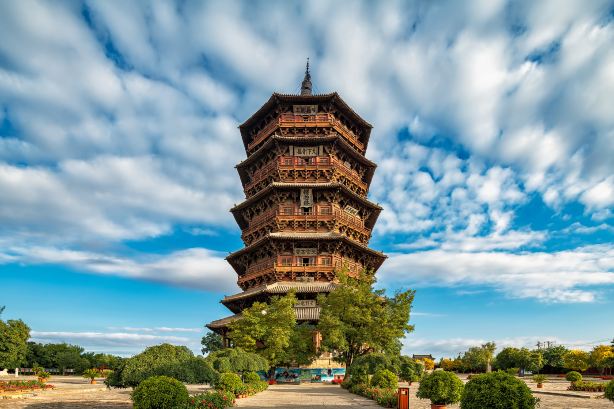
Yingxian Wooden Pagoda
The full name of Yingxian Wooden Tower is Sakyamuni Pagoda of Fogong Temple. It is in the Fogong Temple in the northwest of Yingxian County. The octagonal wooden pagoda has five stories. Except for the high-end stone foundation of the first floor, the rest of the pagoda is made of wood using the traditional craftsmanship of Sunmao. Each layer of the wooden tower is equipped with wind chimes for a pleasant sound when the wind blows.China · Ying County

Baotu Spring
Baotu Spring is located in the bustling downtown area of Jinan, bordered by Qianfo Mountain to the south, Daming Lake attraction to the north, and connected to Quancheng Square to the east. This spring-themed garden is renowned as the "No. 1 spring under heaven" and ranks first among Jinan's "72 famous springs," with a history spanning over 2,000 years. It has also frequently appeared in literary works, most notably in Lao She's "Baotu Spring." Visitors come here to witness the spectacular sight of the three gushing springs. The main spring serves as the park's centerpiece, with its crystal-clear water gushing in three separate jets day and night, reaching several feet high during peak flow. The spring is surrounded by large stone masonry and guardrails, allowing visitors to overlook the spectacular sight of the three jets from the railings. A dark green stone tablet inscribed with "No. 1 spring" stands nearby, bearing the calligraphy of Licheng's Wang Zhonglin from the Tongzhi era of the Qing Dynasty. In the vicinity, over thirty other famous springs are scattered, including Jinxian Spring, Shuyu Spring, Xibo Spring, Liuxu Spring, Huanghua Spring, Dukang Spring, and Bailong Spring. July and August, when local rainfall is abundant, make for the best season to observe these springs. In the height of summer, visitors can get up close with the springs in the park. Some springs have no railings around them, with stone paths in the pools where water flows over. Visitors can step into the pools to interact with the water, walking on the stone paths where their feet will get wet from the cool spring water. Besides water interaction, there are free drinking springs available for visitors by the pools. On the east side of the springs stands the Wangheting teahouse, specially catering to visitors.This springFragrant tea brewed with water at a moderate price. In addition to the springs, another highlight of the park is its magnificent south gate, adorned with grandeur and elegance. The horizontal plaque above the gate, inscribed with "Baotu Spring" in golden characters on a blue background, bears the imperial handwriting of Emperor Qianlong from the Qing Dynasty. It is acclaimed as the "first gate" of Chinese classical gardens. In previous years, seasonal water stoppages frequently occurred here, but through recent conservation efforts, normal water levels have been largely restored. Additionally, the attraction regularly hosts various cultural events. Every year on the first day of the lunar new year, a lantern festival is held for 20 days. In late September, there's a spring water culture festival lasting about 10 days, featuring folk activities, calligraphy and painting exhibitions, and traditional opera performances for visitors to enjoy. From late October to late November, a chrysanthemum exhibition takes place where the golden fall scenery of gushing springs and blooming chrysanthemums creates a spectacular sight well worth seeing. In addition, the attraction has launched a cruise route. After visiting the attraction, interested visitors can board the cruise at the dock, passing through the west gate bridge in Jinan's old town, the east gate of Wulongtan Park, and entering Wulongtan Lock, Jinan's first passenger ship lock in history, where they can experience a drop of over 2 m. Sitting on the east side of the boat, visitors can also see the relief of "Jinan's eight scenic views". The riverbanks along the route are lined with aquatic plants, and the water is crystal clear. The cruise finally passes through Yanbo Bridge and enters the Daming Lake attraction.China · Jinan

Temple of Heaven
The Temple of Heaven is a unique altar for emperors of the Ming and Qing dynasties. Here, people worship the heavens, ask for rain, and pray for a better harvest. It is a famous ancient building in China. The Temple of Heaven is divided into two parts: the Inner Altar and the Outer Altar. Well-known structures such as the Hall of Prayer for Good Harvest and the Echo Wall are located in the Inner Altar. While visiting the Temple of Heaven, tourists get to experience the grand praying ceremony of ancient emperors and observe the ingenious designs such as the Echo Wall and the Triple Sound Stones. The wisdom of the ancient craftsmen will not fail to impress you.China · Beijing
Experiences you can't miss in Ningjin
Featured Day tours in Ningjin
View all Day tours
Free cancellation
Instant confirmation
Book now for tomorrow
From€34.35

From€79.71
Free cancellation
Instant confirmation
Book now for tomorrow
From€63.48

From€151.51

From€212.11
Free things to do in Ningjin
Zhaozhou Bridge
Zhao County · 17.5km from NingjinThe Palace Museum
China · BeijingUniversal Beijing Resort
China · BeijingImmediate access, Book now for todayBailin Temple
Zhao County · 18.6km from NingjinMount Taishan
China · Tai'anImmediate access, Book now for today, Cancel anytimeJinci Temple Museum
China · TaiyuanImmediate access, Book now for today, Cancel anytimePrince Kung's Palace Museum
China · BeijingImmediate access, Book now for todayYingxian Wooden Pagoda
China · Ying CountyImmediate access, Book now for today, Cancel anytimeBaotu Spring
China · JinanImmediate access, Book now for today, Cancel anytimeTemple of Heaven
China · BeijingImmediate access, Book now for today
What travellers say about Ningjin

难 得糊 涂19 September 2026
5.0
The Zhaozhou Bridge Scenic Area, also known as Anji Bridge, was built over 1400 years ago under the supervision of the Sui Dynasty craftsman Li Chun. It is the world's oldest and best-preserved open-spandrel stone arch bridge, often referred to as the "Number One Bridge Under Heaven." It is a 4A-level scenic area and a national key cultural relics protection unit.
The Zhaozhou Bridge itself spans the Xiao River, featuring a single-arch design with four smaller arches added to the shoulders—a groundbreaking innovation in bridge construction. This not only reduced the bridge's weight but also helped divert floodwaters during the rainy season. The bridge's bluestone railings are carved with lifelike dragons and mythical beasts. Currently, climbing the bridge is prohibited, but visitors can admire and photograph it up close from the banks.
The Ancient Bridge Exhibition Hall introduces the bridge's construction principles and historical evolution, showcasing old photographs and models to help visitors understand the engineering wisdom of the ancients.
The Li Chun Statue stands at the entrance of the scenic area, commemorating the designer of this famous bridge.
The riverside gardens along the Xiao River offer excellent views of the bridge's reflection in the water.
Zhaozhou Bridge

300***2319 October 2026
5.0
Guide Su is a fantastic tour guide who takes good care of every visitor. Although the weather was uncooperative and it was raining, we were still able to follow Guide Su's explanations and complete all the procedures, thus successfully concluding our three-hour tour of the Palace Museum.
The Palace Museum

_TI***d620 October 2026
5.0
We had a fun day at Universal Beijing, but the park needs more thrilling rides. Transformers was a highlight, while most other rides were too mild.Kung Fu Panda Land is beautiful but mostly for children. At Jurassic World, only the immersive ride was worth the wait. Minion Land’s immersive ride was okay, but its roller coaster was disappointing. Hollywood was forgettable. We enjoyed the Transformers food and horror attractions.We visited on Monday, arriving at 11 AM. My advice: arrive early and head straight to Harry Potter, then Transformers, to avoid queues and get better photos. Thursday might also be a good choice. I’d avoid Friday to Sunday. Monday can be unpredictable, especially with the Forbidden City closed. Paying extra for activities inside the park after already buying admission was frustrating. Overall, a fun and visually impressive park, but it needs more thrills and fewer extra charges.
Universal Beijing Resort

吹你一脸灰10 October 2025
4.0
Berlin Zen Temple is located at No. 23, Shita East Road, Zhaozhou Town, Zhao County, Shijiazhuang City, Hebei Province. It was first built during the Jian'an period of the Eastern Han Dynasty (196-220 AD). It was called "Guanyin Temple" in ancient times, "Yong'an Temple" in the Southern Song Dynasty, "Berlin Zen Temple" in the Jin Dynasty, and "Berlin Zen Temple" since the Yuan Dynasty. The existing temple buildings (except the Berlin Temple Pagoda) were built in 1992, covering an area of more than 90 acres. It is an important ancestral temple in the history of Chinese Zen Buddhism [2].
Bailin Temple

Anonymous user19 October 2026
4.0
Suggest to reach in in early afternoon for a short trek around the area and catch the sunset. stay for a night to see the sunrise next day. Very beautifu & memorablel views. Great food condidered considered its so high up..
Mount Taishan

星星岩20 October 2026
5.0
This is a very nice attraction. The ancient buildings are well-preserved. I recommend hiring a guide for a more in-depth understanding. A guided tour takes about 1.5 hours. The area is quite large, so you can explore at your own pace if you have time.
Jinci Temple Museum

156***7018 October 2026
5.0
When visiting historical sites in Beijing, the subway is the must-use mode of transportation. Hiring a guided tour is highly recommended. The vast Prince Gong's Mansion came alive under the guidance of Liu, the guide from Xiucai Shuo. After this guided tour, I can easily stroll around the mansion on my own next time. The crowds are larger in the afternoon; the guide said it's better in the morning.
Prince Kung's Palace Museum
Anonymous user19 October 2026
5.0
Every snapshot is a beautiful scene! The park is very well maintained, with picturesque views at every turn and a wonderful atmosphere. The scenery is captivating, offering a high success rate for photos. You don't need to specifically find the right angle; every shot is a beautiful picture, making it a perfect blend of sightseeing and photography.
Yingxian Wooden Pagoda

_We***9020 October 2026
5.0
I visited last year and was lucky enough to admire the chrysanthemums in the garden; this was my second time there. I'll probably go again next time I'm in Jinan. I especially love this kind of ancient architecture; it makes me feel incredibly comfortable.
Baotu Spring

judithb130320 October 2026
5.0
Very calm and relaxing place ! Easy to access with the subway station nearby ! Temple is absolutely stunning
Temple of Heaven


