
Things to do in Hukou
Explore top experiences
Top 10 attractions in Hukou


Xunyang Tower
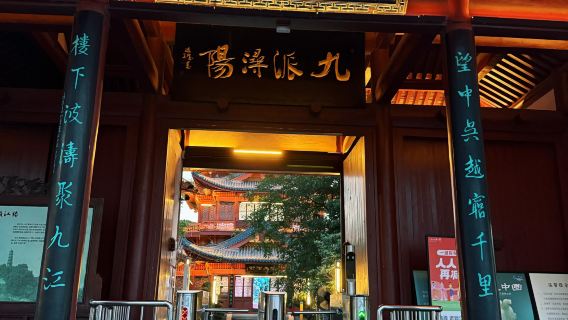
Xunyang Tower is on the banks of the Xunyang River. It was named after Xunyang, which is the previous name of Jiujiang River. Xunyang Tower was originally a restaurant built in the Tang Dynasty. The current Xunyang Tower is a reconstructed building in Song style. Outside, there are three floors, but there are four floors inside. It is a tourist attraction that combines sightseeing, tea drinking, listening to storytelling and dining. Standing on the corridor of the third floor, the Yangtze River is under your feet. The other side of the river is the border of Hubei. The scenery is spectacular.Jiujiang · 24.2km from Hukou

Three Cascades Waterfall
The scenery around Sandie Waterfall changes with the seasons. The waterfall is at its most spectacular in late spring and early summer. Visitors can descend to the foot of the waterfall for a breathtaking view.Lushan City · 28km from Hukou

Suojiang Tower
Suojiang Tower is located on the bank of the Yangtze River in Jiujiang city. When you take a boat into Jiujiang waters, the pagoda of Suojiang Tower (Wenfeng Tower) will come into view. Therefore, Suojiang Tower has become the symbol of Jiujiang. The Suojiang Tower originally had one floor and one tower. In the 14th year of the Wanli reign of the Ming Dynasty (1586), Wu Xiu, the then governor of Jiujiang County, raised funds to build the Suojiang Tower on Huilongji, near the river in Jiujiang, in order to prevent flooding. At that time, it was called Jiangtian Suoyao Tower, which was three stories high. There were four iron bulls next to the tower to suppress water. Later, a 25.26-meter-high pagoda was built in the south of the tower, named Wenfeng Tower, also known as Huilong Tower. There is a wooden ladder in the tower that can spiral up. It was destroyed and restored several times. After liberation, the Suojiang Tower was rebuilt on the original site, covering an area of 18,000 square meters. Two new bronze bulls were cast between the Jiujiang Yangtze River Bridge and the Wenfeng Tower. Each bull is 3.1 meters long, 2.7 meters high, 1.5 meters wide, and weighs 1.5 tons, once again recreating the historical features of the Suojiang Tower with its towers leaning against each other and the bronze bulls suppressing water.Jiujiang · 23.1km from Hukou

Lushan Xiufeng Scenic Area
Xiufeng attraction is located in Lushan City, Jiangxi Province, at the southern foot of Lushan Mountain and by the side of Poyang Lake. It combines famous mountains, waterfalls, springs, and temples in one place, making it a representative and renowned scenic area where natural views and cultural heritage perfectly merge. Historically praised as "Xiufeng's peerless beauty surpasses all under heaven, yet ancient words still fall short," it is now celebrated with the saying "Roam the poetic and picturesque Xiufeng, behold Lushan's waterfalls." The great Song Dynasty poet Su Shi elevated Xiufeng to the pinnacle of Lushan's views, while master calligrapher Mi Fu hailed it as the "first mountain." The iconic Lushan waterfall described in Li Bai's verse—"The sunlit Censer Peak exhales incensed purple smoke; Far off I watch the waterfall plunge to the long river, Flying waters descending straight three thousand feet, Till I think the Milky Way has tumbled from the ninth height of Heaven"—is right here in Xiufeng! Historical records state that Li Jing, the Zhongzhu (Middle Ruler) of the Southern Tang dynasty, built a terrace at the foot of Heming Peak to study when he was young. After ascending the throne, he greatly missed the place where he had studied in his youth. In 951 AD, he issued an imperial edict to donate the site of the old study terrace to build a temple, naming it Kaixian Temple with the implication of "an omen of the founding of a nation." He also invited Chan Master Shaozong, the seventh generation of the Qingyuan lineage, to preside over Kaixian Temple and propagate Buddhism. In the 46th year of the Kangxi reign of the Qing dynasty (1707 AD), Emperor Kangxi toured the south and bestowed a plaque inscribed with "Xiufeng Temple" to the monk Chaoyuan. Since then, it was renamed "Xiufeng Temple," commonly known as Xiufeng. The natural beauty of Xiufeng includes: the Lushan waterfall, which poet Li Bai praised as "The torrent dashes down three thousand feet from high, as if the Silver River fell from the blue sky"; the Qingyu Gorge that calligrapher Mi Fu found too captivating to leave; the rippling Longtan Pool; and the uniquely shaped peaks such as Heming Peak, Shuangjian Peak, Xianglu Peak, Wenshu Peak, and Zimei Peak. Throughout history, Xiufeng has not only attracted countless literati but also enchanted emperors, generals, and celebrities. They wandered among its forests, springs, and waterfalls, composing poems to express their emotions or reflecting on life and times, leaving behind numerous love songs, verses, and treasures. Major historical sites include: the reading platform of Li Jing, the middle ruler of the Southern Tang Dynasty; the Shuanggui Hall established during Emperor Kangxi's southern tour; the Shuyu Pavilion, hailed by Su Dongpo as one of the "Two Wonders of Mount Lu"; Chiang Kai-shek's field headquarters; and attractions like the Clever Spring and the Immortal Bathing Pool. The cliff inscriptions by historical celebrities at Xiufeng are considered an open-air exhibition of Chinese calligraphy art and a masterpiece of harmony between nature and humanity. There are a total of 144 cliff inscriptions (including steles) spanning the Tang, Song, Yuan, Ming, Qing dynasties and modern times. They feature dense quantity, diverse scripts—seal, clerical, regular, running, and cursive—and involve an exceptionally large number of historical figures, covering an extensive time span and distribution area, making them rare even across Mount Lushan and nationwide. These inscriptions solidify Mount Lushan's political, historical, religious, and cultural essence into its majestic landscapes, holding immense academic, cultural, and aesthetic value as the pinnacle of Lushan's heritage. Notable examples include the Tang-era Iron-Wire Guanyin relief (originally by master painter Wu Daozi, later completed by Jiang Yuejing as a full-body portrait), Yan Zhenqing's "Ode to the Revival of the Great Tang," Huang Tingjian's "Seven Buddhas' Gatha" and "Clever Spring" from the Song dynasty, Mi Fu's "First Mountain," Wang Yangming's "Monument of Merits" from the Ming dynasty, and Emperor Kangxi's "Xiufeng Temple" inscription from the Qing dynasty. In 2006, Xiufeng's cliff inscriptions were designated as a "Major Historical and Cultural Site Protected at the National Level" by the State Council, forming a vital part of Mount Lushan's UNESCO World Heritage status. The attraction also features a passenger cable car, offering panoramic views of Tao Yuanming's hometown Shangjing's pastoral scenery, a bird's-eye vista of the vast Poyang Lake, and up-close sights of Li Bai's Lushan and the competing beauty of Mawei Twin Waterfalls. Gaze up at the majestic Heming, Shuangjian, and Xianglu peaks, or venture to Lushan's southern forest park for exploration and nostalgia. “Two mountain waterfalls cascade; foliage thrives in all seasons. Dusk falls unnoticed, as fish and birds linger with visitors.” (Song Dynasty • Hong Peng's “Visiting Xiufeng”). Xiufeng sincerely welcomes friends from around the world to visit and explore.Lushan City · 39.1km from Hukou

Wuyishan National Park
Wuyishan National Park is located in the northern section of the Wuyishan mountain range in northwestern Fujian, stretching across the border area between Fujian and Jiangxi provinces. It is one of China's first established national parks, and Wuyishan itself was inscribed as a UNESCO World Heritage Site for both culture and nature as early as 1999. The park was formed by integrating the former Wuyishan National Nature Reserve and Wuyishan Scenic Area: the Tongmu area in the north focuses on ecological conservation and scientific research, preserving a rare intact mid-subtropical forest ecosystem at this latitude. The main peak of the Wuyishan range, Mount Huanggang, is also located here, and this core area does not offer regular tourism activities. Sightseeing activities are concentrated in the scenic areas along both banks of the Nine-bend Stream, namely the four major sections: Tianyou Peak to Taoyuan Cave, Nine-bend Stream to Wuyi Palace, One-line Sky to Tiger Roaring Rock, and Dahongpao to Water Curtain Cave. The attractions in the scenic area are relatively scattered with considerable distance between them. A leisurely visit typically requires two to three days. If you only have one day, start by ascending Tianyou Peak for a panoramic view of the emerald waters and crimson mountains along the Nine-bend Stream, then take a bamboo raft downstream from Xingcun Wharf. Along the way, you'll pass landmarks like Jade Maiden Peak, Great King Peak, cliff inscriptions, and suspended boat coffins. The rafting journey ends at Wuyi Palace, making it an ideal classic route. Tea enthusiasts may prefer spending time on the leisurely Rock Bone Floral Trail between Dahongpao and Water Curtain Cave. This gentle path connects core Wuyi rock tea production areas like Liuxiangjian and Huiyuankeng, offering a uniquely fragrant experience. With two days, you can cover all four major sections. For more time, consider visiting the ancient tea merchants' residences in Xiamei Village, the starting point of the ancient Tea Horse Road, or exploring the ruins of the Minyue King's City near Chengcun Village—the latter also being part of Wuyishan's world heritage site. Bamboo rafting is very popular, so please make arrangements in advance during peak season. To get close to the ecological heart of the park, you can take the Wuyishan National Park No. 1 scenic route. Places like Moon Bay and Qinglong Waterfall are suitable for self-drive or private charter. As for food, street snacks like flat meat dumplings and Vietnamese noodles are common, while Langu smoked goose and local dishes cooked with alpine bamboo shoots and mushrooms are also worth trying.China · Wuyishan

Donglin Temple
Donglin Temple is located at the northwest foot of Lushan National Park in Jiujiang. It is the birthplace of the Pure Land school of Buddhism and is revered as the ancestral temple of the Pure Land school. When visiting, you can walk slowly along the central axis, where the halls, lotus ponds, and the mountain forest behind them are arranged in layers. A stone arch bridge spans the Huxi Creek in front of the temple. This is the Huxi Bridge, the site of the "Three Laughs at Tiger Creek" legend. Walking north across the bridge for over 100m, you will reach the mountain gate, which features a stone inscription reading "Jin Dynasty Donglin Temple." The name of the main hall, Shenyun Hall, comes from the legend that the timber for building the temple emerged from the pond. The Congming Spring never dries up throughout the four seasons. Legend has it that when the famous Eastern Jin scholar Yin Zhongkan visited, he discussed the "Book of Changes" with Huiyuan by the spring, and their witty remarks flowed like the spring water, hence its name. Today, many visitors still scoop a ladle of spring water for good luck. The remaining stele of the "Stele of Rebuilding Donglin Temple," inscribed by the Tang Dynasty calligrapher Liu Gongquan, records the history of the temple's reconstruction after the Huichang Persecution of Buddhism and is hailed as the "Donglin Wonder." On the west side, the Yuangong Pagoda Courtyard houses the tomb pagoda of Huiyuan. The pagoda is built with stones stacked like lychees, commonly known as the "Lychee Pagoda." In the courtyard, there is also a Buddha's hand camphor tree said to have been planted by Huiyuan himself.Jiujiang · 32.8km from Hukou

Jiujiang Night
Jiujiang at night dazzles with enchanting city views under brilliant lights, attracting both visitors and locals. Through diverse activities, you can experience the city's vibrant energy and warm hospitality while gaining deeper insights into its cultural heritage and development. It's the perfect way to enjoy Jiujiang's nightlife.Jiujiang · 16.8km from Hukou

Hubei Provincial Museum
The Hubei Museum is composed of three antique buildings, including a comprehensive exhibition hall, a Chu Culture Hall, and a bell museum. The layout reflects the ancient Chu architectural concept of "One Hall" and "Multiple Stations". The Hubei Museum boasts four treasures: the Zeng Houyi Chime Bells unearthed in the Tomb of Marquis Yi of Zeng; the exquisite workmanship of the cold weapon era, the King of Yue's Sword of Goujian, the 1 million year-old Xunxian Man Skull Fossil, and the White and Blue Porcelain Plum Vase.China · Wuhan

Qingchuan Pavilion
Qingchuan Pavilion is located on Hanyang's Tortoise Mountain and faces the Yangtze River, across the river from the Yellow Crane Tower. Qingchuan Pavilion was built in the Ming Dynasty and was named after the Tang Dynasty poet Cui Wei. The pavilion as it exists today was rebuilt in the 1980s according to historical photos. The scenic area consists of three main buildings: Qingchuan Pavilion, Wuhan Dayu's Palace, and Tiemenguan. There are also a number of other attractions such as various stone tablets and monuments, decorated archways, and cloisters, all rich in classical Chinese charm. It is very pleasant to climb up to the pavilion, feel the wind from the river, and enjoy the view of the river. The classical architecture and the greenery here complement each other perfectly, and the beautiful scenery has caused this to become a popular spot for wedding pictures in Wuhan.China · Wuhan

Jingdezhen China Ceramics Museum
The Jingdezhen Ceramics Museum is a large-scale ceramics special art museum. The contents of the exhibition are divided into “history department”, “new China department” and special exhibition hall. The Jingdezhen Ceramics Museum exhibits five generations of celadon, the Qing Dynasty white porcelain of the Song Dynasty, and the blue and white porcelain of the Ming Dynasty. Not only can you appreciate the fine porcelain, but you can also learn about porcelain. It is a good place for a relaxing holiday.China · Jingdezhen
Experiences you can't miss in Hukou
Featured Day tours in Hukou
View all Day tours

Free cancellation
Instant confirmation
FromRs 26,155.74
![Poetic Day Tour to Lushan in Nanchang: Enjoy Hidden Alpine Wonderland[Ticket+Private Car]](https://ak-d.tripcdn.com/images/0355u12000re8m0jy1ACE_C_568_320.jpg?_fr=wc)
Free cancellation
Instant confirmation
Book now for tomorrow
FromRs 12,887.65
Free cancellation
Instant confirmation
Book now for tomorrow
FromRs 33,526.89
Free cancellation
Instant confirmation
FromRs 21,970.82
Featured Cultural experiences in Hukou
View all Cultural experiences
FromRs 59,991.73
5.0/5
· 1 reviewFree cancellation
Book now for tomorrow
FromRs 16,361.39
![[Lushan in-depth tour] Full climbing accompaniment/local guide tour/guide + professional itinerary customize](https://ak-d.tripcdn.com/images/0350112000tibttgh543B_C_568_320.jpg?_fr=wc)
FromRs 41,373.61
5.0/5
· 1 reviewFree cancellation
Book now for tomorrow
FromRs 32,910.83
Free things to do in Hukou
Xunyang Tower
Jiujiang · 24.2km from HukouThree Cascades Waterfall
Lushan City · 28km from HukouImmediate access, Book now for today, Cancel anytimeSuojiang Tower
Jiujiang · 23.1km from HukouLushan Xiufeng Scenic Area
Lushan City · 39.1km from HukouWuyishan National Park
China · WuyishanImmediate access, Book now for today, Cancel anytimeDonglin Temple
Jiujiang · 32.8km from HukouJiujiang Night
Jiujiang · 16.8km from HukouHubei Provincial Museum
China · WuhanBook now for tomorrow, Cancel anytimeQingchuan Pavilion
China · WuhanBook now for tomorrow, Cancel anytimeJingdezhen China Ceramics Museum
China · Jingdezhen
More ways to travel from Hukou
What travellers say about Hukou

Eddie 逛吃6 May 2026
5.0
This is a place with a story. We visited to learn about its history and to teach the children. There was a Sichuan opera face-changing performance, but I don't know why Jiujiang would include it. Then there was a brief explanation of the origin of Song Jiang's rebellious poem. The last part was what I found most distasteful: a former calligrapher wrote some calligraphy. He kept saying it wasn't for sale, only for the audience member who cheered the loudest. I immediately recognized the sales tactic. What I disliked was that during the May Day holiday, people from all over brought their children to visit. The children were innocent and focused, listening intently and looking forward to it. When you tell them it's a scam, it's negative, and they won't leave until the end. In the end, it was obvious they wouldn't give it away for free; they charged 200 yuan for the writing. In other words, the calligraphy was written and given away for free; the artwork wasn't actually framed, just a simple scroll with the writing on it. They charged 200 yuan to the viewers. Finally, the children realized it was a scam, learned a lesson about society, and left unhappy. This part was definitely a mistake in this old historical building. Society has developed; even selling calligraphy and paintings using this tactic is outdated. If they had just added more creative souvenirs, fridge magnets, and ice cream, the price would probably have been higher than this, even with more tourists.
Xunyang Tower

300***894 October 2026
5.0
The San Die Quan Waterfall truly lives up to its reputation. The scenery is completely different from Huang Guo Shu Waterfall. Climbing nearly 3000 steps up and down, my legs were shaking.
But the feeling of the waterfall's mist splashing on you after reaching the top was truly magical.
Three Cascades Waterfall

Anonymous user27 April 2026
4.0
The most worthwhile attraction in the scenic area is the Suojiang Tower (a national key cultural relic protection unit). Actually, you can see it very clearly from the outside :) There is a 3D electronic screen inside the tower, and climbing the tower is also a good place to enjoy the river view. However, the design of Suojiang Tower is not user-friendly for viewing the tower.
Suojiang Tower

ghost081012 October 2026
4.0
It's better to take the cable car up and walk down; it saves energy and allows you to see everything you need to see. Unfortunately, we went on a foggy day with low water levels, so we couldn't fully appreciate the atmosphere described in Li Bai's poem. We'll come back during the rainy season.
Lushan Xiufeng Scenic Area

沈墨凡13 October 2026
5.0
There's no excessive commercialization, and the bamboo raft boatmen are quite interesting and don't charge extra. A special shout-out to the "One Line Sky"! Having climbed countless "One Line Skys" across the country, only this one is truly authentic!! A place where you can calmly focus on the scenery, a truly peaceful and beautiful landscape.
Wuyishan National Park

贩卖快乐的贝儿15 July 2025
5.0
- Huxi Bridge: The place where the legendary story of "Three Smiles at Huxi" took place in the history of Chinese culture. The bridge is simple and the surrounding scenery is quiet.
- Heavenly King Hall: One of the important buildings of Donglin Temple. The statues of the Four Heavenly Kings in the hall are solemn and majestic, which makes people awe-inspiring.
- Daxiong Hall: The main hall of Donglin Temple. The Buddha statues in the hall are tall and majestic, with incense smoke and Buddhist chants, solemn and solemn.
- Huiyuan Tomb Tower: Located on the hill west of Donglin Temple, it is the tomb tower of Huiyuan, the founder of the "Pure Land Sect" of Eastern Buddhism. It has a simple shape and profound historical and cultural value.
Donglin Temple

159***5331 July 2025
1.0
Today, a leader arrived, and they were completely clueless about the preparations. The two security guards were just messing around, completely clueless. The security guard even criticized the tourists. We waited half an hour for the iron flower show, and it didn't even last 10 minutes. The show was so far away from where we were supposed to be, we couldn't even see it clearly. The actual show time was completely different from the schedule, and many things weren't going according to plan. How can you say this is a good experience for tourists? No wonder they don't charge.
Jiujiang Night

大土豆一颗4 October 2026
5.0
The exhibited artifacts were quite good; I've also been to joint exhibitions organized by museums like the Hunan Provincial Museum. The Kremlin artifacts here are well-prepared and thoughtfully designed. However, the souvenir and merchandise section was rather boring. I was thinking of buying a pendant or something, but that saved me some money.
Hubei Provincial Museum

沅大王30 September 2026
5.0
The scenic area is filled with the fragrance of osmanthus blossoms. From the top, you can enjoy panoramic views of the Yangtze River Bridge and the Yellow Crane Tower. At the very top, watching the ships on the Yangtze and the cars and trains on the bridge, with the breeze blowing, is very pleasant, and it's not too crowded. The scenic area isn't large; a leisurely hour is about right to appreciate the scenery.
Qingchuan Pavilion and Guishan Scenic Area are directly connected by the Iron Gate Pass, which leads to the West Gate of Guishan. Climbing the mountain and enjoying the breeze and osmanthus fragrance is a wonderful experience.
Qingchuan Pavilion

Dina娜儿3 October 2026
5.0
Taking kids to a museum definitely requires a guided tour! Luckily, we met a great guide – Ms. Yuan! Her explanations were very detailed, and we listened attentively. We bought many souvenirs. The chicken cup is a must-buy! The museum architecture is also stunning – highly recommended!
Jingdezhen China Ceramics Museum


