Things to do in Duchang
Explore top experiences
Top 10 attractions in Duchang

Poyang Lake
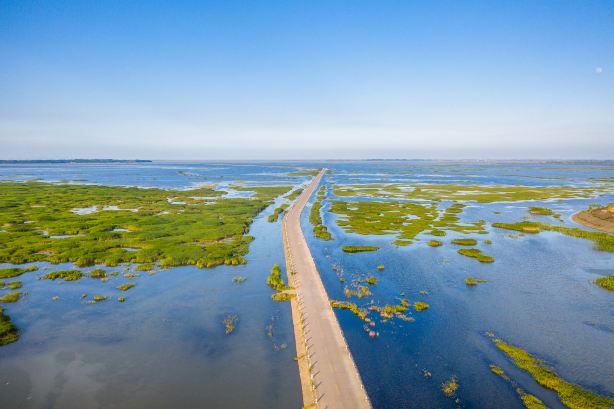
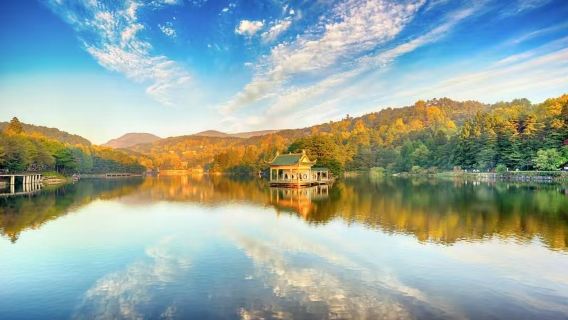
Poyang Lake is located in the northern part of Jiangxi Province, on the south bank of the Yangtze River. It receives water from five rivers—the Gan, Fu, Xin, Rao, and Xiu—and flows into the Yangtze River through Hukou, serving as the "catchment basin" for the Jiangxi water system and a "transfer station" for the five rivers entering the Yangtze. This body of water also carries a rich history; Zhu Yuanzhang and Chen Youliang fought a decisive battle here at the end of the Yuan Dynasty, and the scene described by Wang Bo in his writing, "fishing boats sing at dusk, the sound echoing to the shores of Pengli," refers to this very place. Every year from late autumn to early winter, hundreds of thousands of migratory birds, such as white cranes and swans, fly here from Siberia and Northeast China to overwinter. The vast majority of the world's white cranes gather here, creating a spectacular scene of dancing cranes and calling geese on the lake beaches. Hundreds of Yangtze finless porpoises also inhabit the lake, making this body of water an important home for them in the Yangtze River basin. High and low water levels make the lake seem like two different places: in spring and summer, when the water rises, it is as vast as the sea; in autumn and winter, when the water recedes, sandbars are exposed, and large areas of grassland grow. The rocky island in the heart of the lake, Luoxing Isle, "emerges from the water" as the water level drops, and in the Hukou area, you can see a clear boundary where the clear and turbid waters of the Yangtze River and the lake meet.Duchang · 26.6km from downtown

Lushan National Park
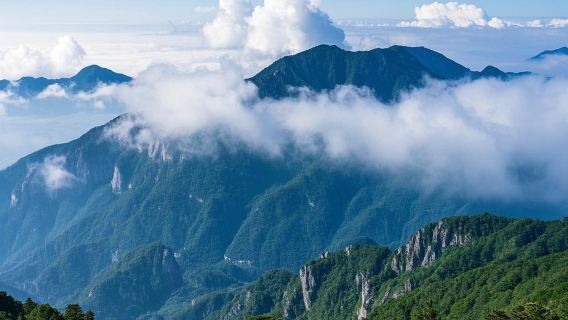
Mount Lu is known as one of China's “four great summer retreats,” together with Jigongshan, Beidaihe, and Mount Mogan. Mountain peaks, waterfalls, unique views of “cloud oceans,” and garden architecture all lend Mount Lu its rich charm. The mountain climate allows visitors to feel the cool and comfortable feel of spring even in the summertime, and has secured Mount Lu's position as a famous scenic area and historic vacation spot and retreat.Lushan City · 35.6km from Duchang

The National Archaeological Site Park of Nanchang Han Dynasty Haihun Marquis
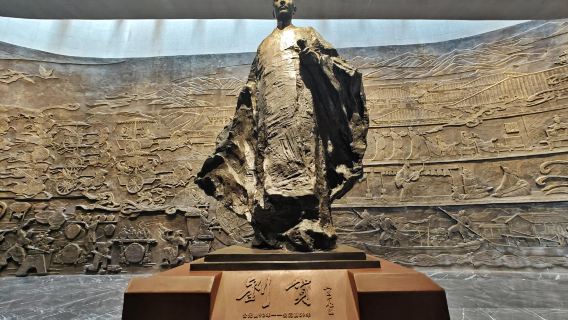
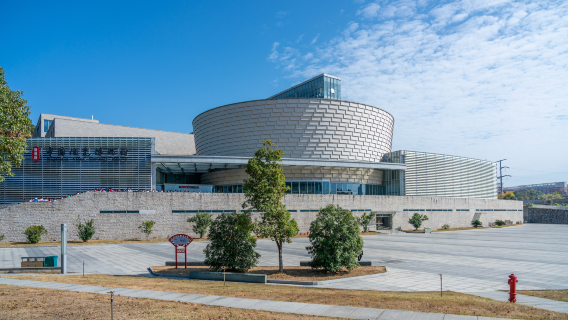
The National Archaeological Site Park of Nanchang Han Dynasty Haihun Marquis was developed based on the capital city ruins of Zijingcheng from the Western Han Dynasty Haihun Marquisate, the mausoleum of its first marquise Liu He, and the burial clusters to the west and south of the city. It represents the most well-preserved and structurally intact settlement ruins of a Han Dynasty marquise state capital discovered in China to date. Liu He, the tomb's occupant, was Emperor Wu's grandson who was deposed after merely 27 days on the throne, later becoming the Haihun marquise and moving south before being buried here. Since archaeological excavations began in 2011, over 10,000 artifacts including goldware, bronzes, jades, lacquerware, and bamboo slips have been unearthed, bringing this historically obscure "deposed Han emperor" back into public view with remarkable completeness. The park is divided into six functional zones: the ruins museum area, tomb exhibition area, Zijingcheng exhibition area, archaeological reserve area, entrance service area, and historical experience & ecological leisure area. The visitor center at the entrance adopts the shape of a jade bi disk—its white circular structure resembles a jade button when viewed from above, symbolizing "offering jade to heaven." The ruins museum takes its design inspiration from the dragon-shaped jade artifact unearthed from Liu He's tomb, appearing like a coiled dragon resting between mountains and waters. Permanent exhibitions such as "Golden Haihun," "Scholarly Haihun," and "Vermilion Lacquer Haihun" are housed here, alongside the interactive "Encountering Haihun" gallery. Among the over 1,000 displayed artifacts, gold items like cakes, horse-hoof ingots, unicorn-toe ingots, and plates are arranged in rows—their quantity and variety being exceptionally rare among excavated Han tombs. A complete set of bianzhong bells and bianqing stone chimes shares the stage with a bronze goose-fish lamp, whose curved neck holds a fish; rotating its dish adjusts brightness while smoke filters through water in the goose's belly without escaping, mirroring the ingenuity of the Changxin Palace lamp. A bronze lamp inscribed with "Nanchang" stands as a rare Han-dynasty physical testament to the city's name. Among the over 5,000 bamboo slips unearthed from the tomb of Liu He, the long-lost "Qi version of the Analects" was discovered after being missing for more than 1,800 years. The restoration achievements are showcased in the "Fragrance of Haichun" bamboo slips exhibition, where over a hundred newly restored original slips are displayed alongside Han Dynasty manuscripts like the "Book of Songs." Travelers who appreciate ancient texts and calligraphy will find it worth a closer look. The wooden back of the lacquered mirror depicting Confucius and his disciples features portraits and biographical accounts. While the original is still under restoration, the museum presents a full-scale replica with enlarged images to highlight details—another exhibit not to be missed. Beyond the museum, the Liu He Mausoleum at Guodun Mountain is another key attraction. The mausoleum complex features a trapezoidal layout, with the two main tombs of Liu He and his marquise wife sharing the same burial ground but in separate chambers at the central elevated platform. Surrounding them are auxiliary burial sites and remnants of ritual structures such as ancestral halls, resting chambers, garden walls, and gate towers. Outside the complex lies a rare chariot-and-horse burial pit seldom seen south of the Yangtze River. The Guodun Yuan ruins exhibition area built atop the mausoleum offers a panoramic view of the main tombs' wooden chamber structure from an encircling observation deck, while a 360-degree suspended screen recreates the mausoleum's construction process and Han Dynasty marquise funeral rites. The chariot pit preserves its original excavated state, with a restored quadriga carriage model showcasing the grandeur of Han nobility's travels. The park is planned around the grand heritage site, covering a vast area with its core visitable zones concentrated at the traveler center, ruins museum, and Liu He's tomb complex. The Zijingcheng city site is primarily preserved in its original state, so focus your visit on the museum and tomb area. As distances between zones are considerable, shuttle services are available—we recommend allocating half a day. The Han-style gate towers and golden imperial carriage at the entrance are popular photo spots. Throughout the park, Han cultural activities like costume parades and themed markets occasionally take place; keep an eye out while exploring the exhibitions.Nanchang · 37.4km from Duchang

Lushan Xiufeng Scenic Area
Xiufeng attraction is located in Lushan City, Jiangxi Province, at the southern foot of Lushan Mountain and by the side of Poyang Lake. It combines famous mountains, waterfalls, springs, and temples in one place, making it a representative and renowned scenic area where natural views and cultural heritage perfectly merge. Historically praised as "Xiufeng's peerless beauty surpasses all under heaven, yet ancient words still fall short," it is now celebrated with the saying "Roam the poetic and picturesque Xiufeng, behold Lushan's waterfalls." The great Song Dynasty poet Su Shi elevated Xiufeng to the pinnacle of Lushan's views, while master calligrapher Mi Fu hailed it as the "first mountain." The iconic Lushan waterfall described in Li Bai's verse—"The sunlit Censer Peak exhales incensed purple smoke; Far off I watch the waterfall plunge to the long river, Flying waters descending straight three thousand feet, Till I think the Milky Way has tumbled from the ninth height of Heaven"—is right here in Xiufeng! Historical records state that Li Jing, the Zhongzhu (Middle Ruler) of the Southern Tang dynasty, built a terrace at the foot of Heming Peak to study when he was young. After ascending the throne, he greatly missed the place where he had studied in his youth. In 951 AD, he issued an imperial edict to donate the site of the old study terrace to build a temple, naming it Kaixian Temple with the implication of "an omen of the founding of a nation." He also invited Chan Master Shaozong, the seventh generation of the Qingyuan lineage, to preside over Kaixian Temple and propagate Buddhism. In the 46th year of the Kangxi reign of the Qing dynasty (1707 AD), Emperor Kangxi toured the south and bestowed a plaque inscribed with "Xiufeng Temple" to the monk Chaoyuan. Since then, it was renamed "Xiufeng Temple," commonly known as Xiufeng. The natural beauty of Xiufeng includes: the Lushan waterfall, which poet Li Bai praised as "The torrent dashes down three thousand feet from high, as if the Silver River fell from the blue sky"; the Qingyu Gorge that calligrapher Mi Fu found too captivating to leave; the rippling Longtan Pool; and the uniquely shaped peaks such as Heming Peak, Shuangjian Peak, Xianglu Peak, Wenshu Peak, and Zimei Peak. Throughout history, Xiufeng has not only attracted countless literati but also enchanted emperors, generals, and celebrities. They wandered among its forests, springs, and waterfalls, composing poems to express their emotions or reflecting on life and times, leaving behind numerous love songs, verses, and treasures. Major historical sites include: the reading platform of Li Jing, the middle ruler of the Southern Tang Dynasty; the Shuanggui Hall established during Emperor Kangxi's southern tour; the Shuyu Pavilion, hailed by Su Dongpo as one of the "Two Wonders of Mount Lu"; Chiang Kai-shek's field headquarters; and attractions like the Clever Spring and the Immortal Bathing Pool. The cliff inscriptions by historical celebrities at Xiufeng are considered an open-air exhibition of Chinese calligraphy art and a masterpiece of harmony between nature and humanity. There are a total of 144 cliff inscriptions (including steles) spanning the Tang, Song, Yuan, Ming, Qing dynasties and modern times. They feature dense quantity, diverse scripts—seal, clerical, regular, running, and cursive—and involve an exceptionally large number of historical figures, covering an extensive time span and distribution area, making them rare even across Mount Lushan and nationwide. These inscriptions solidify Mount Lushan's political, historical, religious, and cultural essence into its majestic landscapes, holding immense academic, cultural, and aesthetic value as the pinnacle of Lushan's heritage. Notable examples include the Tang-era Iron-Wire Guanyin relief (originally by master painter Wu Daozi, later completed by Jiang Yuejing as a full-body portrait), Yan Zhenqing's "Ode to the Revival of the Great Tang," Huang Tingjian's "Seven Buddhas' Gatha" and "Clever Spring" from the Song dynasty, Mi Fu's "First Mountain," Wang Yangming's "Monument of Merits" from the Ming dynasty, and Emperor Kangxi's "Xiufeng Temple" inscription from the Qing dynasty. In 2006, Xiufeng's cliff inscriptions were designated as a "Major Historical and Cultural Site Protected at the National Level" by the State Council, forming a vital part of Mount Lushan's UNESCO World Heritage status. The attraction also features a passenger cable car, offering panoramic views of Tao Yuanming's hometown Shangjing's pastoral scenery, a bird's-eye vista of the vast Poyang Lake, and up-close sights of Li Bai's Lushan and the competing beauty of Mawei Twin Waterfalls. Gaze up at the majestic Heming, Shuangjian, and Xianglu peaks, or venture to Lushan's southern forest park for exploration and nostalgia. “Two mountain waterfalls cascade; foliage thrives in all seasons. Dusk falls unnoticed, as fish and birds linger with visitors.” (Song Dynasty • Hong Peng's “Visiting Xiufeng”). Xiufeng sincerely welcomes friends from around the world to visit and explore.Lushan City · 31.5km from Duchang

Three Cascades Waterfall
The scenery around Sandie Waterfall changes with the seasons. The waterfall is at its most spectacular in late spring and early summer. Visitors can descend to the foot of the waterfall for a breathtaking view.Lushan City · 34.8km from Duchang

White Deer Grotto Academy
The White Deer Grotto Academy is seated in the southeast of Wulao Peak. It is a key culture relic protection unit in China. During Zhen Yuan Period in the Tang Dynasty, Li Bo, feudal provincial governor of Jiangzhou lived and studied here, and raised a white deer. He was then named as "Mr. White Deer." The White Deer Grotto Academy faces the south, and uses the stone-wood or wood-brick structure. The roof of the academy is of herringbone hard peak, reflecting the elegance and the spirit of not seeking for fame and wealth. The White Deer Grotto Academy is one the four major academies in China. Zhu Xi, a rationalistic Confucian philosopher, rebuilt the academy, and gave his lectures here.Lushan City · 31.4km from Duchang

Donglin Buddha
Donglin Buddha is located at the southern foothills of Lushan National Park and is a giant outdoor bronze statue of Amitabha Buddha built by the abbot of Donglin Temple, the ancestral temple of the Pure Land sect. Cast in tin bronze and gilded all over, it sits on a 48-petal lotus pedestal. Such a scale is rare among similar Amitabha Buddha statues. The 48m Buddha body and the 48-petal lotus pedestal echo the traditional theme of the 48 Great Vows of Amitabha Buddha. The statue adopts the style of the High Tang Dynasty, and its design incorporates the strengths of ancient statues such as the Vairocana Buddha at the Longmen Grottoes. The right hand hangs down with the palm facing outward, as if welcoming visitors, while the left hand holds a lotus at the chest. When looking up from the square, the Buddha's eyes seem to be constantly watching the viewer.Lushan City · 34.8km from Duchang

Lu Mountain Ropeway
The Lu Mountain Ropeway isMount LuA domestic transportation cable car with its upper station located on Huiyuan Road in Guling Town, Lushan City, and the lower station at Lushan Yunwu Tea Plantation in Bailihu New District, Jiujiang City, adjacent to the ancient Donglin Temple with a history of over a thousand years.The cableway spans a total length of 2,864m with an elevation difference of 873m. Each cabin is designed to accommodate 30 visitors, supported by just 4 towers along the entire route, featuring a single-span distance of 1,567m. It operates at a speed of 7m/s with a capacity of 4,000 visitors per hour. This cableway utilizes advanced double-cable support and single-cable traction technology with detachable 30-person cabins. Officially launched on July 28, 2017, it takes visitors only 7 minutes to reach the mountaintop.Lushan City · 39.9km from Duchang

Tengwang Pavilion Tourist Area
Tengwang Pavilion Tourist Area is located on the east bank of the Gan River in Nanchang, with the riverside Tengwang Pavilion as its centerpiece. Originally built in the fourth year of the Yonghui era of the Tang Dynasty by Li Yuanying, Prince of Teng and son of Emperor Gaozu of Tang, it gained eternal fame through Wang Bo's "Preface to Tengwang Pavilion." Alongside the Yellow Crane Tower and Yueyang Tower, it is hailed as one of the "Three Great Towers of Jiangnan." Historically destroyed and rebuilt nearly thirty times, the current structure is a Song-style replica completed in 1989, designed based on Liang Sicheng's reconstruction sketches. With its green tiles and layered eaves, it remains a landmark of Nanchang to this day. The main pavilion follows a "three visible, seven concealed" layout: appearing as a three-story structure with encircling corridors from the outside, while actually containing seven interior floors—nine levels including the two-tiered base symbolizing ancient city walls. Turquoise-roofed galleries extend north and south from the base's flanks, connecting at their ends to auxiliary pavilions named "River-taming" and "Greenery-embracing," forming a mountain-shaped silhouette with the main tower. Below, an artificial lake and the nine-bend wind-and-rain bridge add classical garden charm to the majestic architecture. Each floor of the pavilion offers something remarkable. The white marble relief "A timely wind delivers Tengwang Pavilion" in the first-floor preface hall depicts the legend of Wang Bo riding the wind to compose his famous preface. The second-floor mezzanine features the long scroll painting "Gallery of eminent figures," gathering Jiangxi's historical luminaries like Tao Yuanming, Ouyang Xiu, Wang Anshi, and Tang Xianzu in one artwork. The third-floor mural "Linchuan dream" recreates Tang Xianzu's staging of "The peony pavilion" here. The fourth-floor "Land of wonders" painting compresses Jiangxi's iconic landscapes—Mount Lu, Sanqing Mountain, Dragon-Tiger Mountain, and Poyang Lake—into a single masterpiece. The fifth floor is the highlight for panoramic views: its central hall displays a bronze tablet inscribed with Su Dongpo's calligraphic version of "Preface to Tengwang Pavilion," while the east hall exhibits a scale model of the pavilion. Strolling the veranda offers sweeping views of the Gan River and modern skyline across the water. The top floor bears the plaque "Ninth heaven," with its west hall housing an antique-style theater flanked by replica ancient instruments like chime bells and stone chimes. Above, spiral-arranged bracket sets adorn the caisson ceiling, and between the double eaves hangs Su Dongpo's gilded "Tengwang Pavilion" plaque. After descending from the main pavilion, take time to explore the garden area: the square in front of the pavilion, the grand Song-style archway, the antique street lined with calligraphy and antique shops, and the small Suzhou-style garden Fuchang Garden with its lake reflections and bridge views—perfect for slowing your pace. To experience the poetic scene of "a solitary wild duck flying with the sunset glow, while the autumn water blends with the vast sky," an evening ascent to the pavilion is ideal. The fifth-floor corridor offers an expansive view, making it a prime spot to admire the sunset over the Gan River.Nanchang · 72.9km from Duchang

Mount Huangshan Scenic Area
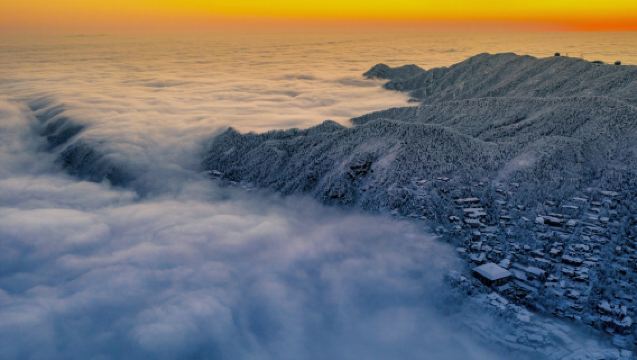
Mount Huangshan is famous for its long history. "You would not want to visit mountains after visiting the Five Sacred Mountains, and you would not want to visit the Five Sacred Mountains after visiting Huangshan." Xu Xiake, a great traveler and geographer of the Ming Dynasty, twice ascended Huangshan to witness its magnificence, exclaiming it as "a wonder in life." Dramatic Pines, grotesque rocks, sea of clouds, and hot springs are known as the “Four Musts” of Huangshan. They are the uncanny workmanship of nature and cannot be missed. In addition, the haze, snow scene, and sunrise are unique landscapes of Huangshan. Each landscape has its unique beauty and makes you feel like you are in a fairyland.China · Huangshan City
Experiences you can't miss in Duchang
Featured Day tours in Duchang
View all Day tours
Free cancellation
Instant confirmation
From€84.42

Free cancellation
Instant confirmation
Book now for tomorrow
From€133.26

From€240.34

Free cancellation
Instant confirmation
Book now for tomorrow
From€41.60
Free cancellation
Instant confirmation
Book now for tomorrow
From€108.20
From€194.81
Featured Cultural experiences in Duchang
View all Cultural experiences
From€5.33

Free cancellation
Instant confirmation
From€23.91

From€16.03

From€193.61

From€333.81
Free things to do in Duchang
Poyang Lake
Duchang · 26.6km from downtownLushan National Park
Lushan City · 35.6km from DuchangImmediate access, Book now for today, Cancel anytimeThe National Archaeological Site Park of Nanchang Han Dynasty Haihun Marquis
Nanchang · 37.4km from DuchangImmediate access, Book now for today, Cancel anytimeLushan Xiufeng Scenic Area
Lushan City · 31.5km from DuchangBook now for tomorrow, Cancel anytimeThree Cascades Waterfall
Lushan City · 34.8km from DuchangImmediate access, Book now for today, Cancel anytimeWhite Deer Grotto Academy
Lushan City · 31.4km from DuchangImmediate access, Book now for today, Cancel anytimeDonglin Buddha
Lushan City · 34.8km from DuchangLu Mountain Ropeway
Lushan City · 39.9km from DuchangImmediate access, Book now for today, Cancel anytimeTengwang Pavilion Tourist Area
Nanchang · 72.9km from DuchangImmediate access, Book now for today, Cancel anytimeMount Huangshan Scenic Area
China · Huangshan CityBook now for tomorrow
What travellers say about Duchang

乂昭17 October 2024
5.0
China's largest freshwater lake, with water reaching the sky and rippling blue waves. The water level has dropped during the dry season, and large areas of wetland grasslands have appeared, which is also unique. Poyang Lake near Jiujiang City is Hukou, and there is Luoxingdun scenic spot in Lushan City. There are many lake landscapes in the south until Nanchang.
Poyang Lake

_We***9015 October 2026
4.0
Perhaps it's because you can't see anything on a rainy day, so I don't dare to say much about the scenery. You can usually see colorful birds in this season, but there's nothing happening now. However, I feel that the scenic area's management is still a bit lacking.
Lushan National Park

spf_5418 October 2026
5.0
The shuttle bus is really convenient. There are many boarding points, all in areas where tourists congregate. It's a direct route with no transfers, and the return trip is quick and easy, saving time and money. Our guide, Mr. Xie, is diligent, responsible, polite, and speaks with great manners. His museum tour was excellent value for money, though not mandatory. The two-hour tour was very professional, and I was very satisfied. It would be even better if the shuttle bus had stronger cooling.
The National Archaeological Site Park of Nanchang Han Dynasty Haihun Marquis

ghost081012 October 2026
4.0
It's better to take the cable car up and walk down; it saves energy and allows you to see everything you need to see. Unfortunately, we went on a foggy day with low water levels, so we couldn't fully appreciate the atmosphere described in Li Bai's poem. We'll come back during the rainy season.
Lushan Xiufeng Scenic Area

300***894 October 2026
5.0
The San Die Quan Waterfall truly lives up to its reputation. The scenery is completely different from Huang Guo Shu Waterfall. Climbing nearly 3000 steps up and down, my legs were shaking.
But the feeling of the waterfall's mist splashing on you after reaching the top was truly magical.
Three Cascades Waterfall

181***8019 July 2026
5.0
It was great! I went back after ten years. There was a free shuttle bus at the entrance of the scenic area to take you to the entrance of the academy. It was fantastic! There were also activities such as pitch-pot, chess, and lacquer fan making at the entrance of the scenic area.
White Deer Grotto Academy

sky~li29 August 2025
4.0
This is the world's largest golden statue of Maitreya Buddha, two meters taller than the Statue of Liberty, and 30 kilometers of gold were poured into its body. A straight staircase leads directly to the statue. Worshippers should walk on the right side, where the wooden flooring makes it easy to bow. Tourists should walk on the left side, where the terrazzo flooring is tiled. This scenic area is free, built with donations from believers from around the world. However, entry is restricted after 5:30 PM, so it's recommended to visit early in the morning.
Donglin Buddha
杰瑞游中国9 October 2026
5.0
Lushan Mountain, if you have enough time, you really should spend three or four days exploring it at a leisurely pace. I only had an afternoon and a morning for a rushed tour. East Route: Three-Tiered Spring (2600 steps up and down, a real challenge!), Five Old Men Peak (you absolutely must climb to the top; I recommend climbing from one to five in order, try it and see!), Hanpokou, Dakou Waterfall (the water volume in the off-season is really...😅😅😅), Lulin Lake, Lushan Museum (Mao Zedong's former residence). West Route: Ruqin Lake, Fairy Cave, Bai Juyi's Thatched Cottage, Flower Path, Meilu, Lushan Conference Site. For meals, head to the main street of Guling Town; there are so many good places to eat! Food? Tonight you absolutely must watch "Romance on Lushan Mountain," a classic old movie that connects all the scenic spots of Lushan. It's a short film, perfect for a Guinness World Record attempt!
On the road, the sightseeing cable car and shuttle bus are must-buys; walking will leave you exhausted.
The shuttle bus is 70 yuan for 7 days—a great price! The drivers are generally very friendly, and since it's the off-season, there seem to be more buses than people, so there's no need to wait excessively or queue. 🫰🫰🫰 For the return trip from Lushan, there's a direct bus from the lower cable car station to the Lushan High-Speed Railway Station for 10 yuan, a 20-minute ride.
Lu Mountain Ropeway

Anonymous user18 October 2026
5.0
The Tengwang Pavilion scenic area is definitely worth a visit. Besides showcasing the changing dynasties and architectural features, you can also see the characteristics of buildings from different periods, as well as Liang Sicheng's modern renovations. Each floor has different exhibits, including scenery from Jiangxi Province and introductions to famous figures. It can get quite hot inside, so it's best to arrive early in the morning. Like a museum, you can enjoy views of the Gan River from the outside, as well as the Twin Towers and the Bayi Bridge across the river. Highly recommended.
Tengwang Pavilion Tourist Area

_We***2319 October 2026
5.0
"Having seen the Five Sacred Mountains, one need not see other mountains; having seen Huangshan, one need not see the Five Sacred Mountains." Seeing it with your own eyes, you'll understand that this saying is no exaggeration! We traveled with our elders and chose the cable car route, which was less strenuous, avoiding the need for a full hike. The ancient welcoming pine tree is beautifully shaped, and strangely shaped rocks are scattered throughout the mountains. If you're lucky, you might even witness a sea of clouds, with mist flowing among the peaks like a scene from a traditional Chinese ink painting. The Bright Summit offers a panoramic view of the rolling mountains. The mountain path has many steps and some sections are steep, so be sure to bring hiking poles, walk slowly, and rest frequently. The temperature on the mountain is lower than at the foot, so remember to bring an extra jacket. The scenic area has excellent facilities and rest stops along the way. Although it's physically demanding, the magnificent scenery makes it all worthwhile and highly recommended!
Mount Huangshan Scenic Area


