▲ Hie Shrine was established in 1605, dating back to the construction of Takayama Castle, and is a historically significant shrine where the land was returned to its guardian deity. The shrine features a vermilion torii gate with a long staircase in front, flanked by stone lanterns and maple trees. The grounds are also home to towering cedar trees, exuding a profound sense of history and elegant style. As an Inari shrine, visitors can also see statues of foxes, the messengers of the Inari deity.

▲ Opening hours: 8:30 AM–4:30 PM. It's about a 20-minute walk from the Ancient Street in the mountains.


▲ The Takayama Old Town originated in the 16th century as a castle town of Takayama Castle, then under the rule of Kanamori Nagachika, a retainer of Toyotomi Hideyoshi. The Kanamori clan spent approximately 20 years modeling Takayama Castle after Kyoto's architectural layout, earning the town the nickname "Little Kyoto of Hida." In the 19th century, Takayama became a direct territory of the Tokugawa shogunate and the capital of the Hida Mountains region. The small town developed orderly old streets lined with merchant houses, attracting wealthy traders from across Japan. The well-preserved historic district today reflects its former prosperity.


▲ The ancient street is lined with rows of dark-toned wooden buildings in Japanese style, perfectly preserving the architectural style of the Edo period. The wooden lattice exteriors, each with unique designs, exude an antique charm. The middle section of the street, known as Sanmachi, consists of Ichino-machi, Nino-machi, and Sanno-machi, where Edo-era residences remain remarkably intact. Most of these buildings are over 300 years old, retaining their original appearance and interior furnishings from the Edo period, making them a precious cluster of historic structures. The area has been designated as an "Important Preservation District for Groups of Traditional Buildings."


▲ Located on the east bank of the Miyagawa River, stretching approximately 350 meters from Kajibashi Bridge to Yayoi Bridge, this area features over 60 stalls and is one of Japan's three major morning markets. Visitors can purchase fresh fruits, vegetables, local specialties, and handicrafts while enjoying snacks like Hida beef buns and miso senbei as they stroll.


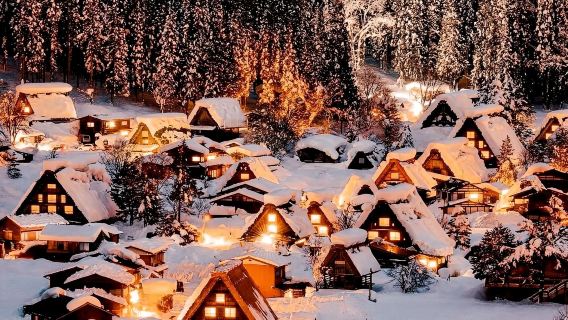
▲ The Gassho village is situated on a plateau about 500m above sea level along the Shogawa River, spanning approximately 1.5km from north to south and 350m from east to west. In 1995, Shirakawa-go and the villages of Gokayama were collectively designated as a UNESCO World Heritage site under the name "Historic Villages of Shirakawa-go and Gokayama." Every year from mid-January to late February, weekend light-up events are held, transforming the snow-covered thatched roofs into a magical scene bathed in warm orange glow.


▲ Legend has it that after the Genpei War in the 13th century, the defeated Taira clan fled into the mountains to escape the pursuing Minamoto clan. They used local reeds to build gassho-style houses resembling two hands pressed together in prayer, which allowed for easy relocation and winter survival—thus giving rise to these unique structures. These buildings are approximately 400 years old, with each gassho-zukuri house being over a century in age.


▲ Winter (December–February): This is the peak season for Shirakawa-go's Gassho village, especially in January and February. The village is covered in thick snow, and the thatched-roof houses look like gingerbread houses from a fairy tale, creating a magical winter wonderland. From mid-January to late February, the village hosts a light-up event on weekends. As night falls, the orange lights illuminate the snow-covered roofs, creating a dreamlike scene. However, temperatures are low during winter, so be sure to dress warmly. Also, advance booking is required for visiting Shirakawa-go.


▲ Summer (June–August): A less crowded season compared to winter, when the rice fields are lush green, creating a picturesque contrast with the gassho-zukuri houses. After planting, the paddies reflect like mirrors, and you can witness the rare "inverted gassho" phenomenon. Additionally, Shirakawa-go serves as a summer retreat with verdant mountains and villages adorned with sunflowers and hydrangeas, exuding a fresh, Japanese-drama-like ambiance. Spring (April–May) brings cherry blossoms and rapeseed flowers, while fall (October–November) showcases vibrant autumn foliage. These seasons also offer uniquely beautiful scenery in Shirakawa-go's gassho-zukuri village.