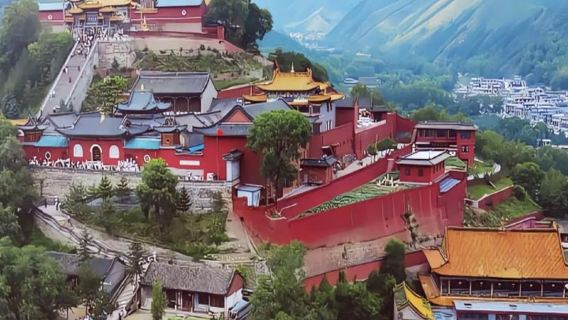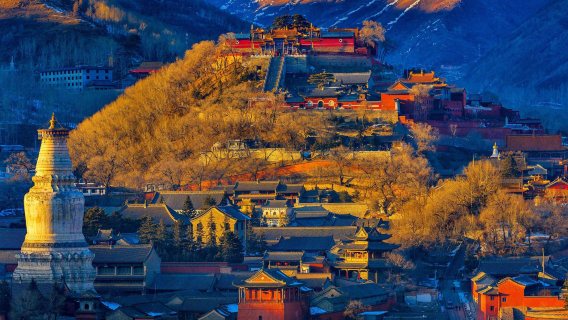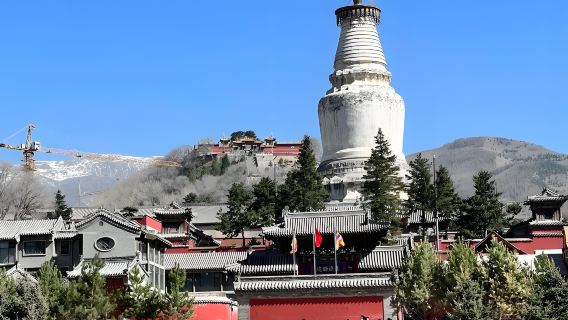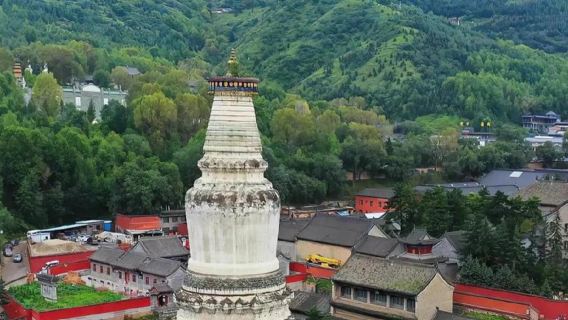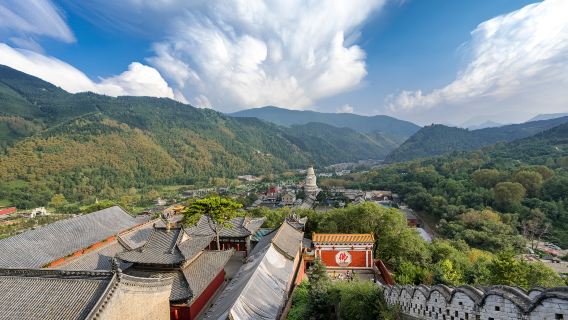
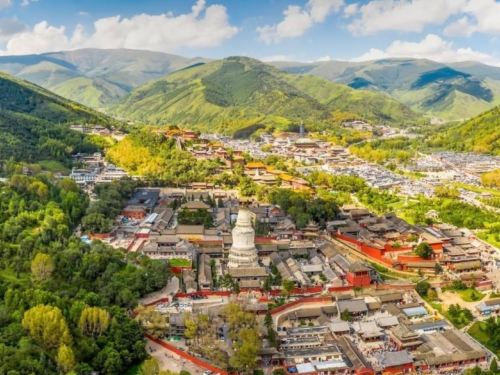
Gather at the designated location and take an air-conditioned tour bus to one of China's Four Sacred Buddhist Mountains – Shanxi's Wutai Mountain (approximately 3 hours by car). Upon arrival, the first stop is: to worship at Wuye Temple, part of the Wutai Mountain scenic area's Ten Thousand Buddhas Pavilion, a temple renowned for its strong incense, effective prayers, and responsiveness to all requests. Although not large, covering only 2,000 square meters with just over 20 halls and rooms, Wuye Temple is widely known and attracts countless pilgrims due to the presence of the Wuye (Fifth Master) Temple within. The Ten Thousand Buddhas Pavilion was founded in the Ming Dynasty, with most of its current buildings being remnants from Qing Dynasty renovations. It features three main structures: the Manjushri Hall, the Five Dragon King Hall, and an ancient opera stage. Thousands of devotees come here daily to worship and pray for blessings. The second stop is: to visit Shuxiang Temple, the ancestral temple of Manjushri Bodhisattva on Wutai Mountain. Shuxiang Temple is located 1 km southwest of Taihuai Town on Wutai Mountain and is one of Wutai Mountain's five great Chan monasteries, named for the Manjushri Bodhisattva enshrined within. It was founded in the early Eastern Jin Dynasty, rebuilt in the Tang Dynasty, and again in the Yuan Dynasty (Taiding 2nd year), but later destroyed by fire. It was rebuilt in the Ming Dynasty (Hongzhi 9th year, 1496) and renovated during the Wanli period, with a stele commemorating the renovation inside. In 1983, it was designated a key national temple in Han Chinese areas. Thousands of devotees come to worship here daily. The third stop is: to visit Xiantong Temple (approximately 40 minutes), one of Wutai Mountain's five great Chan monasteries, the head of all temples on the mountain, and one of China's earliest temples, alongside Luoyang's White Horse Temple. Xiantong Temple is located on the north side of Taihuai Town on Wutai Mountain. It is the largest and oldest temple on Wutai Mountain, also one of Wutai Mountain's five great Chan monasteries and the head of all temples on the mountain, sharing the distinction of being one of China's earliest temples with Luoyang's White Horse Temple. The temple was first built during the Yongping era of the Eastern Han Dynasty (69 AD), initially named Dafu Lingjiu Temple. It was expanded during the Northern Wei Emperor Xiaowen's reign, renovated in the Tang Dynasty, and renamed "Dahua Yan Temple." Rebuilt in the early Ming Dynasty, Emperor Taizu bestowed the name "Daxiantong Temple." The temple faces south, covers an area of approximately 80,000 square meters, and contains over 400 buildings, most of which date from the Ming and Qing dynasties. Seven halls are built along the central axis: Guanyin Hall, Manjushri Hall, Mahavira Hall, Wuliang Hall, Qianbo Hall, Bronze Hall, and Sutra Repository. The Bronze Hall, cast in the 38th year of Ming Wanli (1610 AD), used 100,000 catties of copper and is one of the best-preserved bronze halls in China. The fourth stop is: to worship at Luohou Temple (approximately 30 minutes), one of Wutai Mountain's ten great Yellow Temples. Wutai Mountain's Luohou Temple was the earliest center for the spread of Esoteric Buddhism, and is one of Wutai Mountain's ten great Yellow Temples and one of its five great Chan monasteries. Luohou Temple was founded in the Tang Dynasty, rebuilt in the Ming Dynasty (Hongzhi 5th year, 1492), and renovated multiple times during the Qing Dynasty. Luohou Temple covers an area of over 15,000 square meters and includes 18 structures such as the mountain gate, Hall of Heavenly Kings, bell and drum towers, Manjushri Hall, Mahavira Hall, side halls, rear halls, sutra repository hall, halls, and corridors. The pair of stone lions in front of the mountain gate are Tang Dynasty stone reclining lions. To the left of the mountain gate is a brick pagoda in Tibetan style, over ten feet tall, called Manjushri Pagoda, with carved images of Manjushri. The main statues within Luohou Temple's halls exhibit distinct Lamaist characteristics. The fifth stop is: to visit the iconic building of Wutai Mountain – the Great White Pagoda at Tayuan Temple. Tayuan Temple is located south of Xiantong Temple in Taihuai Town on Wutai Mountain and is one of Wutai Mountain's famous five great Chan monasteries. This was originally the pagoda courtyard of Xiantong Temple. After the stupa was rebuilt in the Ming Dynasty, it became an independent temple, named Tayuan Temple (Pagoda Courtyard Temple) due to the Great White Pagoda within its grounds. The Great White Pagoda, soaring into the clouds, is the main symbol of the temple. The full name of the pagoda is Sakyamuni Sarira Pagoda, commonly known as the Great White Pagoda. The pagoda rises majestically from the ground, towering impressively amidst the cluster of Wutai Mountain temples, and is regarded as the symbol of Wutai Mountain. This pagoda stands 75.3 meters tall and has a circumference of 83.3 meters.
Alternatively, you can choose to have full-day free time to worship the Five-Directional Manjushri Bodhisattva at Wutai Mountain. Emperor Kangxi once visited the holy site of Dailuoding three times. There is a widely circulated saying in Wutai Mountain: "If you come to Wutai Mountain and don't climb Dailuoding, you haven't truly visited Wutai." You can hike up the 1,080 steps of the Great Wisdom Road to worship the Five-Directional Manjushri Bodhisattva. Dailuoding is also known as Daluding or Qingfeng, located on the east side of Taihuai Town, Wutai Mountain, Shanxi Province, next to the Qingshui River, covering an area of 48,000 square meters. Dailuoding is the name of a small mountain peak, and the temple is built on the mountaintop, hence it is called "Dailuoding." Dailuoding was first built during the Chenghua period of the Ming Dynasty (1465–1487) and rebuilt during the Wanli period. In the 15th year of Emperor Qianlong's reign (1750), it was renamed Daluding; it was not until the 51st year of Qianlong's reign (1786) that it was renamed Dailuoding. Dailuoding faces west from the east, and the temple complex is not large, with 48 halls and monks' quarters inside. Along the central axis, from west to east, are the Hall of Heavenly Kings, the Zhanlin Hall, the Hall of Five Manjushri, and the Mahavira Hall. The main attractions include the Hall of Five Manjushri and the Mahavira Hall. Afterwards, take a bus back to Baoding, concluding your pleasant journey!